The Advertising Business is Still Problematic
A prerequisite to reading this post is that you watch Childish Gambino's music video for his song "This Is America." Just as Gambino makes intricate references to Jim Crow Era society throughout the production, we must be able to reflect on the inequities within our communities that result from historical oppression.

Even if you consider yourself critical of messages from media, chances are you don't draw their connection to social inequalities. The advertisement industry is a giant area in which gender inequality is allowed to fester. To better understand how advertisements are able to perpetuate harmful ideas regarding gender, it is important to critically analyze them for their latent meaning.
In recent years, television ads have been known to be promote desexualization of black women, primitivization of black men, and the feminine mystique.
Heineken set an example of subjugating minority women through their recent ad for light beer.
Women in advertisements are often reduced to objects. The woman must be dehumanized before she becomes a marketing tool. Within this context there are many details that paint this picture of hierarchy.
It is clear that the Heineken ad sexualizes the lighter-skinned woman because of her long flowing hair and form-fitting white dress. Contrarily, the first black woman is presented having no hair and wears a light blue blazer that does not accentuate her body. The second black woman has a short haircut although her clothing is slightly more revealing. Each visual cue promotes difference in not only the way women are perceive but the services they are provided. For instance, the two black women are not served drinks—nor the black man playing music—but the bartender makes sure that the lighter-skinned woman gets the satisfaction of a cool beverage. Such advertisements contribute to the constant devaluing of black women.
Black women have a history of being depicted in the media as “sexually sterile.” The most pervasive examples were Aunt Jemima and Mammy Two Shoes. Because the Mammy is traditionally a caretaker, she is utilized to equate black women with infertility and aversion to raising children of their own. As such, because she lacks autonomy she has a reduced status.
This past Winter, H&M received backlash after it released an advertisement campaign for boys’ clothing. Social media users brought attention to two of their models, one young white boy wearing a sweatshirt with the words “Survival Expert” and one black boy wearing a different one with the words “Coolest Monkey in the Jungle.”
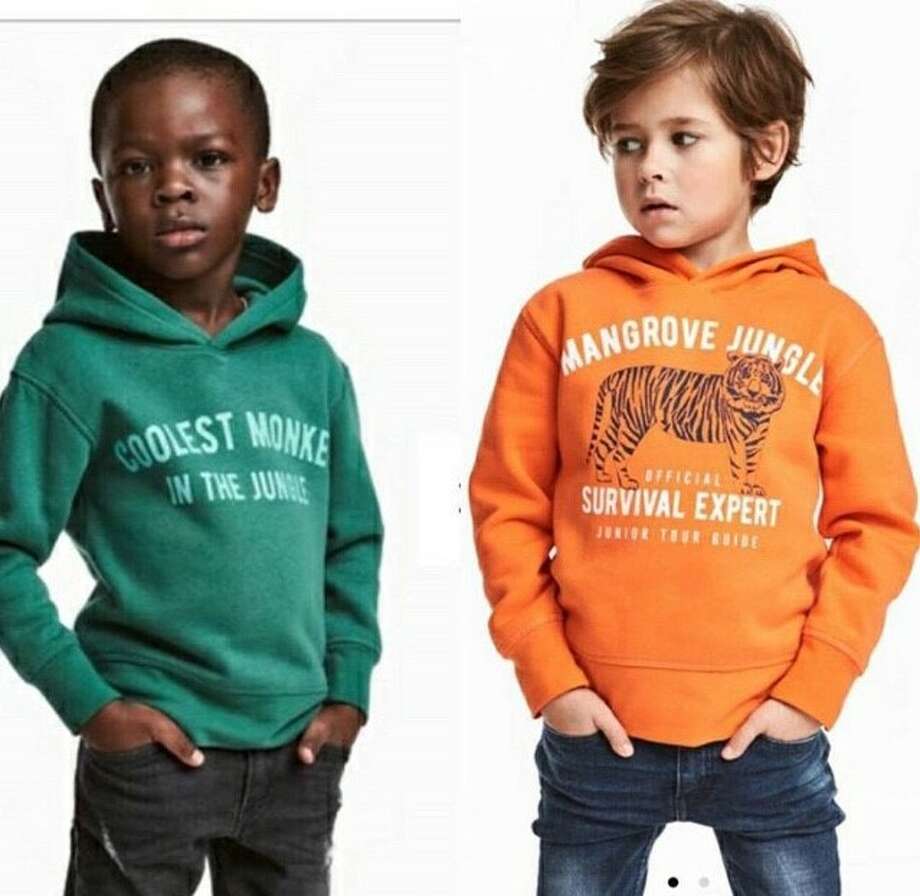
Pause. Before you react, know that the mother of the black boy didn't find the ad offensive, even when she sat through the photo shoot. But know that the majority of Black Americans did.
By dressing up a black boy in a hoodie that calls him a monkey, it reinforces very insidious stereotypes. Black men are depicted in the media as sexually aggressive and violent, regardless of intention. These traits carry unfavorable connotations to them and that is consequently the same notion that people associate with black men. All the relevant traits are captured by words like “thug” and “super-predator,” which despite their connotation have been frequently employed as synonyms for black men.
Where do women fit into the picture? If you look at older advertising it's clear that the fear of the threatening black man has been fueled by the equally as malignant fear of the black sexual predator. The message to white men was if they did not look down upon black men then they would be putting their wife and daughters at risk. And because this belief was indoctrinated into the white conscious, white supremacy prevailed for decades to come.

And the end of the Jim Crow era didn't entail an end to the stereotypes. This image still has grave consequences in the real world, such as increased discipline of black boys in the school system and the killing of black men. The fact that the two boys in the ad are wearing clothes distinguishing one as a survivalist and one as a monkey affirms the message that black boys should be treated like monkeys. The formal apology made by H&M later on should ignite hope for the eradication of these ideas.
Some Super Bowl watchers were upset after Mr. Clean aired their provocative ad in 2017.
The ad quite evidently evokes the feminine mystique, a term originating from the 1960s that describes the societal belief that women’s sole responsibility is to fulfill household duties and be subordinate to men. The ad very much romanticizes a man’s involvement in household cleaning as if that alone exemplifies gender equality. In doing this the implication is that cleaning is a woman’s job, so when men clean it is to be appreciated as a gift. And in this case women should reward it with intimacy.
Intimacy is not just hinted at toward the finale; it is rampant throughout the clip. The tone is created by the background music, by the suggestive lyrics, and even by the lighting that deifies Mr. Clean, as well as the enthusiasm with which the woman responds. The ad closes with the woman’s fantasy ending. The seductive Mr. Clean transforms into the woman’s husband, and once the woman comes back to her senses she ambushes her husband with kisses. The dramatic yet humorous ending further pushes the idea of female subordination...
...because a man is receiving appraisal for performing a job in which appraisal is rarely given to women.
Advertisements in today’s media are a window to understanding large issues such as the desexualization of black women, the dehumanization of black males, and the feminine mystique.
Although every business has a specific target audience, all are complacently pandering to white heterosexual men. Advertisements in general condone ideas that benefit the most privileged group, whether or not they market their products to women and people of color. Companies need to be more receptive to their customers’ wishes if they are the consumers filling their pockets. It is only when the businesses consider us to be equally as important as the dominant group that we will see substantial change.


Comments
Post a Comment